




















Jerusalem, 12 February, 2026 (TPS-IL) — Israel is heading toward a burial space crisis as a rapidly aging population and continued demographic growth are set to dramatically increase the number of annual deaths, according to a study released on Thursday.
The report, prepared by the Taub Center for Social Policy Research in Israel, warns that the country’s long-standing burial policy — which guarantees every citizen a state-funded grave near their place of residence, preserved indefinitely — is no longer sustainable. Israel is currently the only high-income country that both finances burial for all citizens and legally guarantees burial close to home.
Annual deaths, which in recent years have averaged about 45,000–50,000, are expected to more than double to over 100,000 by the mid-2040s. By the end of the 2070s, the figure is projected to exceed 200,000 per year, and in the 2090s could surpass 250,000 annually. In the 26 years between 2024 and 2050 alone, more Israelis are expected to die than in the entire period from the country’s founding in 1948 through 2023 — roughly 2.18 million compared to 2.12 million.
According to the study, the surge stems from a combination of Israel’s high birth rate and the aging of the “baby boomer” generation born in the state’s early decades. The annual growth rate in deaths, which has hovered around 1.1%, is projected to rise to approximately 3.85% in the coming decades.
Prof. Alex Weinreb, head of the Taub Center’s Department of Demography and Director of Research, said policymakers must confront difficult decisions. “Israel is faced with a choice between adhering to existing burial patterns that are not sustainable, in which ‘the dead take from the living,’ and between adopting burial solutions that were practiced in ancient times — Sanhedrin burial (burial in niches) combined with Eretz Israel burial (the custom of collecting bones),” he said.
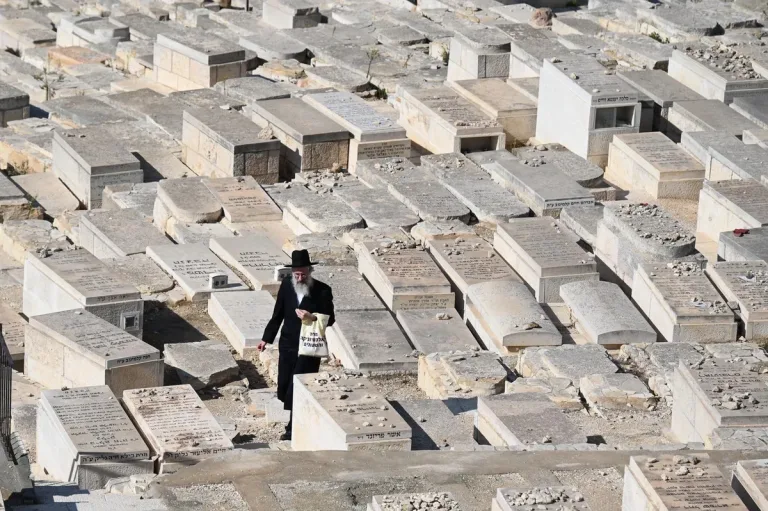
The study argues that without a comprehensive national strategy, Israel risks running out of burial space, particularly in the densely populated central region where land reserves are already scarce. Even major cemeteries serving the Tel Aviv metropolitan area are expected to reach full capacity as early as 2035, decades ahead of schedule.
Compounding the problem, the Ministry of Religious Services — which oversees burial planning and funding — acknowledged it lacks up-to-date national data on available burial plots or long-term mortality forecasts. As a result, planning remains fragmented and largely short-term.
If current burial practices continue, Israel will need to allocate approximately 3,327 dunams (about 823 acres) of additional land for cemeteries by 2050 alone. Because the law requires burial near residential areas, most of that demand would fall on central Israel, where land is among the country’s most expensive and limited resources.
Cremation, a common alternative in many Western countries, is prohibited by Jewish law.
Instead, the study proposes reviving an ancient Jewish practice known as “Eretz Israel burial.” Under this method, the deceased is first buried in the ground, and after about a year the bones are collected and placed in a small stone or clay ossuary within a family burial structure. This approach, used from biblical times through the Talmudic era, allows for burial densities of roughly 3,000 people per dunam — ten times that of standard single-grave “field burial” and double that of modern multi-level or niche burial systems.
“It is important to understand that this is an issue that has substantial social and economic implications, and that without a profound change in perception and long-term strategic planning, we will soon face a serious crisis whose consequences will affect not only us but also future generations,” Weinreb said.
A lack of planning, he warned, would lead to the formation of massive “cities of the dead” in central Israel.
Related Topics