
















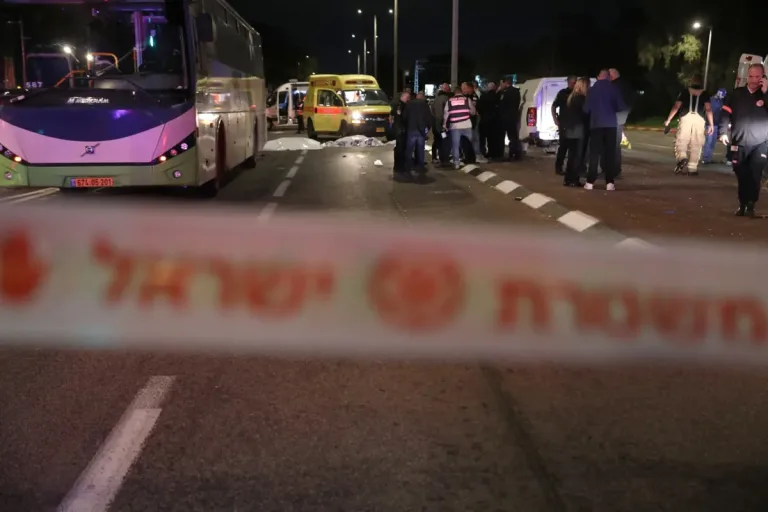
Jerusalem, 12 February, 2026 (TPS-IL) — Five Arab citizens of Israel were shot dead in separate incidents across the country within 24 hours, as a surge in violence has pushed the homicide rate in Arab communities to nearly one killing per day in 2026.
“We are in a state of national emergency,” said Police Commissioner Danny Levy during a briefing with senior commanders. “The war on criminal organizations requires a root cause treatment by all government ministries.” He called for harsher sentencing, faster indictments, and the restoration of investigative technological tools, arguing that police efforts are hindered “when our hands are tied, our ears are blocked and our eyes are covered.”
The first killing occurred in the coastal Arab town of Fureidis, where 48-year-old Muhammad Qassem was shot near a mosque and a local medical clinic. He was evacuated in critical condition while paramedics performed CPR but was pronounced dead on the way to the hospital. Investigators said the inquiry is in its early stages.
Later that night in the southern Bedouin city of Rahat, 22-year-old Mukhtar Atta Abu Madiam was found shot inside his vehicle. Paramedics pronounced him dead at the scene. Police said three suspects were arrested.
Abu Madiam was the son of former Rahat mayor Atta Abu Madiam and had survived an earlier attempt on his life four months ago. His father accused authorities of failing to prevent the killing despite known threats. “He has no problems with anyone. It’s difficult. We know who the shooter is, and we ask the police to do everything so that those who shot him and killed him go to prison and rot,” Abu Madiam said. “Enough with the bloodshed, I lost a child. I never imagined I would be among those who lost their children. I shouted into every microphone against the violence. My son is a great boy.”
About an hour after the Rahat shooting, Sheikh Najib Abu Reesh, 42, an insurance agent from the northern village of Yarka, was shot dead. Paramedic Salem Harika said he “suffered very serious gunshot wounds and was without signs of life. We were forced to declare him dead on the spot.” Police established checkpoints in the area in an effort to apprehend those responsible.
By morning, 60-year-old Hussein Abu Rakeik was found with fatal gunshot wounds in Lod, a mixed Jewish-Arab city in central Israel. Paramedic Ayala Yakubov described arriving to find him “lying on the floor with very serious penetrating injuries. He had no signs of life, and we were forced to declare him dead at the scene.”
The fifth victim, Farid Abu Mubarak, was found with gunshot wounds in Segev Shalom, a Bedouin town near Beersheba. Paramedic Yair Abu Regela said, “We found a man without a pulse and not breathing, with serious injuries. We evacuated him while performing CPR to Soroka Hospital, where he was pronounced dead.”
The killings came two days after a nationwide protest organized by Arab local leaders demanding stronger government action against organized crime.
Since the beginning of the year, 45 people have been killed in incidents linked to criminal violence in Arab towns and neighborhoods, nearly one homicide each day. The surging violence continues a record year in 2025, when 252 Arab citizens of Israel were killed in homicides. The numbers are attributed to organized crime groups fighting turf battles and attempting to eliminate rivals. Arab criminal organizations have been involved in extortion, money laundering, and trafficking in weapons, drugs, and women.
Critics argue the crime wave has worsened since Itamar Ben-Gvir, a far-right politician, became National Security Minister in 2022.
Related Topics